


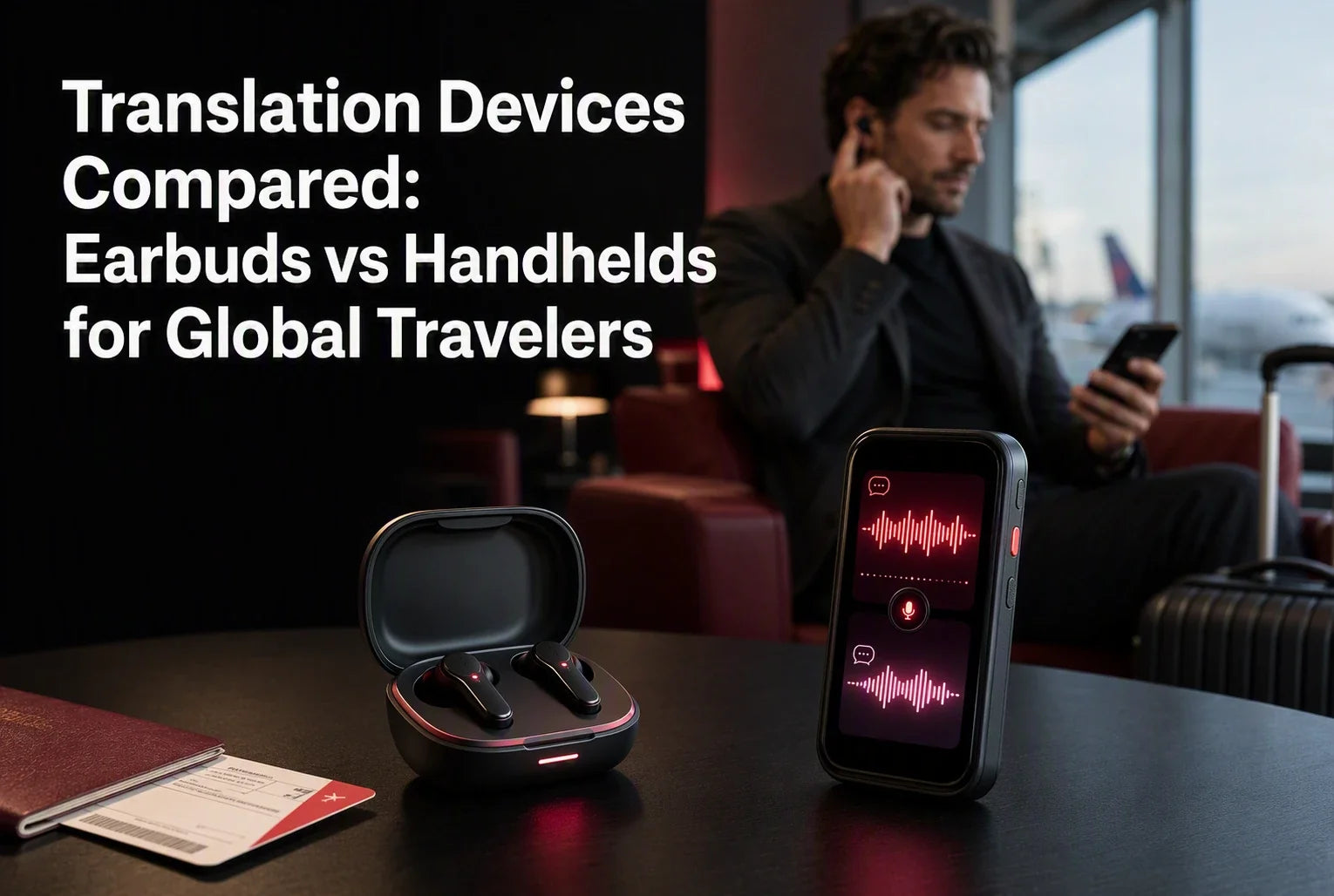
At a Lisbon market, hands-free translation keeps the chat natural. On a call with a supplier in Seoul, Mymanu ORB suits travellers who need open-ear sound, music, calls and street awareness. The best translation earbuds support spoken moments; handheld translator devices suit menus, signs, shared use and phone-free tasks.
Travellers face a real earbuds vs translator choice. Earbuds keep talk moving through sound, while handhelds put words on a screen. This guide tests the best translation earbuds and handhelds for calls, meetings, offline use, privacy, battery and value. It separates useful facts from sales claims, so you can choose with confidence.
Translation Earbuds vs Handheld Translators: At a Glance
| Translation earbuds | Handheld translator devices | |
|---|---|---|
| Best for | Hands-free conversations, calls, movement and listening | Shared conversations, signs, menus and visible text |
| Hands-free use | Strong, with audio-led interaction | Limited, normally requires holding or tapping |
| Offline translation | Model dependent, usually limited to selected pairs | Model dependent, with selected offline modes |
| Visual translation | Usually limited or phone dependent | Strong, often including camera and text translation |
| Connectivity | Often requires a phone, app, Wi-Fi or mobile data | May use built-in SIM, Wi-Fi or offline packs |
| Everyday audio | Available on some models, including Mymanu ORB | Usually specialist translation only |
How Translation earbuds and Handheld translator devices Compare
Translation earbuds
Translation earbuds put speech in your ear, so you can stay present while walking, talking or taking calls. They suit travellers who want hands-free help and listeners seeking the best translation earbuds, with models such as Mymanu ORB also handling everyday audio.
Key strengths
- Hands-free, audio-led use
- Useful for calls and movement
Handheld translator devices
Handhelds place translations on a screen and through a speaker. They suit menus, signs and shared talks, with camera translation a central strength.
![Handheld translator displaying a translated restaurant menu beside a café table]
Key strengths
- Clear screen for shared text
- Camera-based translation
How Each Format Handles Real Conversations
One-to-One Travel Conversations
Earbuds suit a quick chat at a Lisbon market, checking a train platform, or asking for help in Tokyo. You can listen and reply without holding a screen between you and the other person. Handheld translators work well when you need to share text, show a name or address, or pass one device across a counter.
- Choose earbuds for walking, ordering food, and longer chats.
- Choose a handheld for clear turn-taking and visible translations.
- Pause after short phrases. Noise, slang, and two people speaking at once still cause errors.
Presence, Comfort and Social Ease
A phone-like device can make a chat feel like a task. Earbuds leave your hands free and help you keep eye contact, which supports shared attention in live talk, according to conversation research.
Keep the device in the background. Translation should support listening, not replace it.
Mymanu ORB can feel more natural for casual chats, while a handheld suits formal meetings where both people want to check each phrase.
Also Read: 7 AI Translation Earbud Use Cases for Travel in 2026
Calls, Meetings and Professional Communication
Calls and Short Supplier Conversations
For a quick call with a supplier in Seoul, earbuds keep your hands free to check samples, notes or a delivery list. Speak in short turns, pause for the translation, then confirm names, quantities and dates aloud.
- Use a quiet room and one speaker at a time.
- Repeat any price, part number or deadline.
- Keep a written record for terms that matter.
Translation helps the conversation move, but it should not replace a clear written confirmation.
Meetings, Presentations and Records
Use a handheld device when several people need to see the translated text, such as a client briefing or site visit. Earbuds suit one-to-one talks better. Meeting speech is hard for any system because people interrupt and speak over each other, as NIST meeting research notes.
| Situation | Best format | Why |
|---|---|---|
| Supplier call | Earbuds | Private, hands-free listening |
| Group meeting | Handheld | Shared screen and clear turn-taking |
| Formal record | Written follow-up | Checks terms and meaning |
Also Read: Mymanu Orb Reviews: Features, Pricing, and Real Use Cases
Offline Translation and Connectivity Abroad
What Offline Support Usually Means
Offline mode usually means a device has downloaded language files for basic phrases before you leave. It can help with simple needs, such as ordering food, asking for directions, or reading short signs when signal drops.
It does not mean every feature works without the internet. Speech accuracy, rare terms, long sentences, and live conversation often need a connection.
Download the languages you need while on trusted Wi-Fi, then test a few phrases before boarding.

Built-In Data Versus Phone Dependence
A handheld with built-in mobile data can work without your phone, which is useful if your battery dies or you cannot buy a local SIM. Earbuds usually rely on a paired phone and its data plan, but keep your hands free and your focus on the person speaking.
The US State Department advises checking roaming, local SIM, or eSIM options before travel. Public Wi-Fi can help, but treat it with care.
| Setup | Best use | Main limit |
|---|---|---|
| Built-in data | Independent travel | Less choice of apps |
| Phone-linked earbuds | Natural conversations | Needs phone power and connection |
Keep a charger and key phrases ready. Technology should support listening, not pull you out of the moment.
Language Coverage, Screens and Accessibility
Speech, Accents and Written Context
Check the language pair, not just the total language count. A device may support Spanish and Korean, yet struggle with a fast regional accent, café noise, or slang.
Earbuds keep your hands free and eye contact intact, which helps during a chat with a supplier in Seoul. Handhelds give both people a screen, so you can check names, addresses and numbers before acting.
Speak in short turns. Translation works better when each person pauses, then lets the other reply.
Menus, Signs and Accessibility Needs
A screen matters for menus, train signs and hotel details. Choose a handheld when written text is the main task. Choose earbuds when listening and natural conversation matter more.
Captions can help deaf and hard-of-hearing people follow spoken words, as NIDCD explains. Look for large text, clear contrast and a simple control layout.
| Need | Better format | Why |
|---|---|---|
| Face-to-face talk | Earbuds | Keeps attention on people |
| Menus and signs | Handheld | Shows text clearly |
| Hearing support | Screen-based option | Gives a written backup |
Also Read: Phone-Call Translation: 7 Ways Real-Time Call Translation Works
Battery, Portability and Everyday Value
One Trip, Many Charging Decisions
Earbuds reduce what you carry. Their case tops them up between flights, calls and a café stop, but adds one more USB-C item to your packing list. Handheld translators often last longer per charge and are easier to share, yet they take space beside your phone.
The US Department of Transportation lists consumer electronics and power banks with lithium batteries as hazardous materials for transport, so check your airline's rules before flying with spares. DOT guidance
Pack the cable you already use for your phone. A device that needs a special lead is easy to leave behind.
One Device or Specialist Tool
Choose earbuds if sound matters after the conversation too. Mymanu ORB can stay with you for music, calls and short exchanges at a market in Lisbon.
Choose a handheld if you need a clear shared screen during a supplier meeting in Seoul. It keeps the translation visible to both people.
| Format | Everyday value | Main trade-off |
|---|---|---|
| Earbuds | Translation, calls and music | Less useful for shared reading |
| Handheld | Dedicated screen and controls | Another device to carry |
Also Read: https://mymanu.com/blogs/buying-guides-comparisons
Which Should You Choose: Translation Earbuds or a Handheld?
Choose Translation Earbuds If You Want to Stay Hands Free
Choose earbuds for live, spoken exchanges where eye contact matters. They suit ordering lunch in Lisbon, asking for directions, or joining a call with a supplier in Seoul. You can listen, reply, and keep your phone in your pocket.
- Pick earbuds for walking, meetings and one-to-one chats.
- Choose an open-ear fit if you need to hear traffic too.
- Check offline language support before flying.
Translation helps the talk move forward. It should not replace listening closely.
Choose a Handheld If You Need Text, Photos or Shared Access
Choose a handheld when words must be seen by both people. It’s better for menus, signs, forms, addresses and longer text. A screen also gives a clear turn-taking point in a busy group.
| Need | Better format |
|---|---|
| Natural spoken chat | Translation earbuds |
| Reading a sign or menu | Handheld |
| Sharing text with several people | Handheld |
Check app permissions before using either format. The FTC advises reviewing what information an app can access, especially location, contacts and photos.
Keep conversations natural and your phone out of sight. See how Mymanu ORB brings hands-free translation, clear sound and music together for travel and work.
Frequently Asked Questions
Q1: Which translation device is best for hands-free travel conversations?
Translation earbuds suit walking tours, taxis, and markets. You can keep eye contact while the device handles speech. Handhelds work better when noise is high.
Q2: Can translation earbuds replace handheld devices for business meetings?
Not fully. Earbuds help small, informal talks, but handheld screens make turn-taking clearer in formal meetings.
Q3: How do offline capabilities compare between earbuds and handheld translators?
Both may offer offline language packs, but choices and accuracy often shrink. Download packs before travel.
Q4: Do translation devices work with slang?
They can miss slang, accents, and local humour. Use short, plain sentences and confirm important details.
Conclusion
Choose earbuds when hands-free talk, music and staying present matter most. Choose a handheld for shared screens, longer exchanges and clear turn-taking. Test offline language packs before travel, and check app permissions, as the FTC advises. The best device supports the conversation without becoming its focus.

Share:
Cross-Cultural Communication Tools for Better Global Conversations